We use cookies to run this site. With your consent, we also use them for our demo scheduler, analytics and marketing, including identifying the companies and people who visit us. Change your choice anytime under "Cookie Preferences".Privacy Policy
🚀 Dextr AI raised $6.7M to bring an AI workforce to hospitality. Learn more 🚀 Dextr AI raised $6.7M to bring an AI workforce to hospitality. Learn more
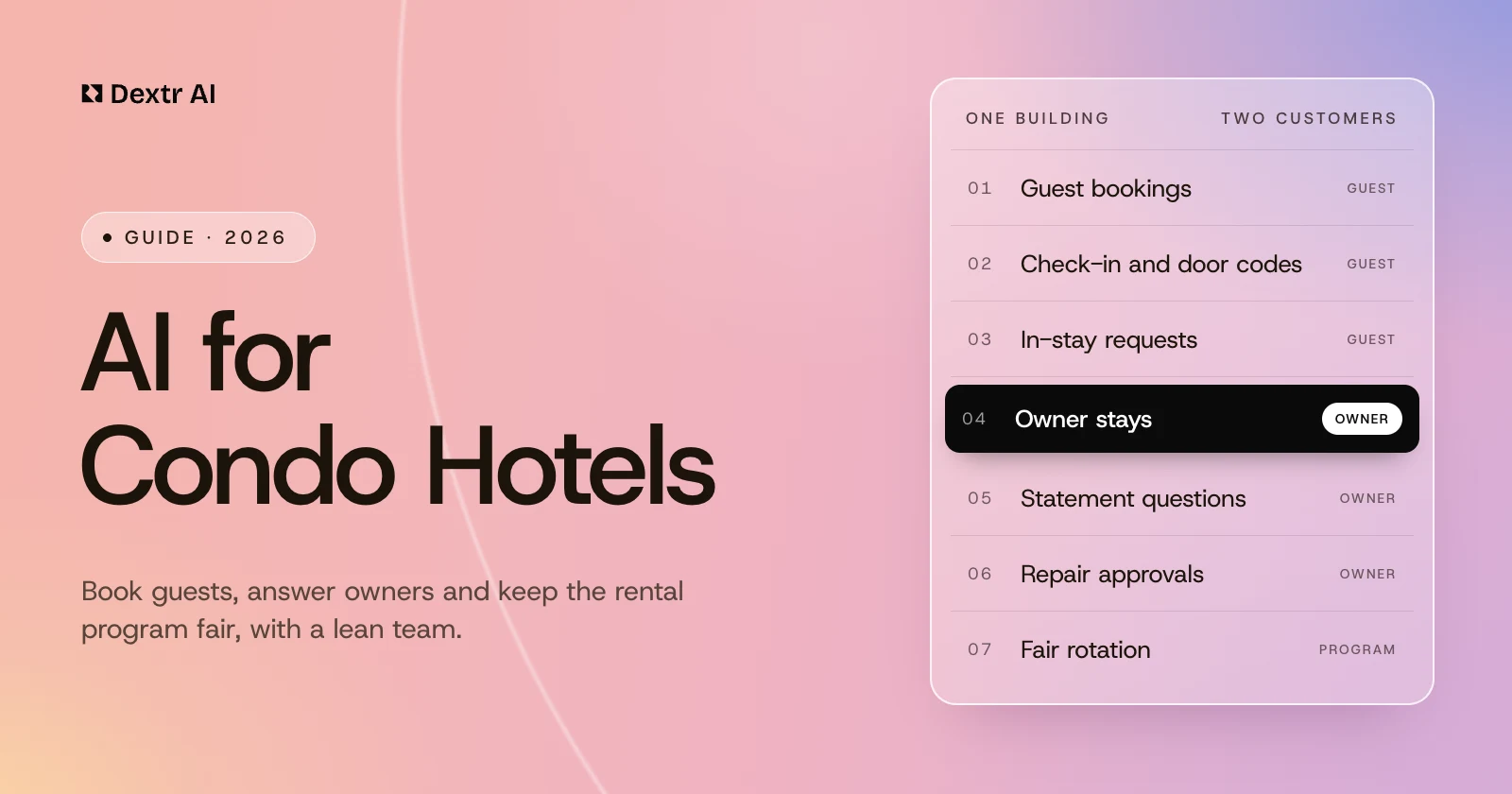
AI for Condo Hotels: How to Serve Guests and Unit Owners With a Lean Team
A condo hotel answers to two customers: the guests who book the units and the owners who own them. Here is how AI agents can handle both, which rental-program rules they must follow, what they must never say, and what staff should keep.
AI for condo hotels means AI agents that serve both of a condo hotel’s customers: guests and unit owners. For guests, they answer calls and messages 24/7, book stays into the property management system (PMS) and send check-in details and door codes. For owners, they handle owner-stay requests, statement questions and repair approvals within the rental program’s rules.
A condo hotel, or condotel, is a building of individually owned units that are rented like hotel rooms through a rental program. That adds two rules: every reply must follow the rental management agreement, and the AI must never discuss expected rental income, because units marketed that way can be treated as securities under federal securities law. Done well, AI gives guests a hotel-grade answer at 2 a.m. and owners a faster reply than an email to the front office.
Key takeaways
A condo hotel serves guests and unit owners. An AI agent must recognize which one it is talking to and apply different rules to each.
The rental management agreement is the AI’s rulebook: owner-use limits, blackout dates, how units are assigned, repair approval limits and what owners may see.
Revenue splits usually sit near 50/50. Where booking commissions come off the rate before the split, every booking moved from an online travel agency (OTA) to direct raises both the owner’s and the operator’s share.
Never let an AI agent discuss expected rental income, occupancy or tax benefits. The SEC has treated condo units offered with that kind of pitch, including oral representations, as securities since 1973.
Let the PMS assign units under the program’s rotation or pooling rules. The AI should book by unit type, and every manual override should carry a reason.
Start with after-hours guest calls, keep owner requests in shadow mode until the rules hold, and measure direct-booking share, owner response time and rotation overrides.
How Condo Hotels Work, and Why They Are Harder to Run
Legally, a condo hotel is a condominium. Each owner holds title to a unit, and an owners’ association governs the condominium, though in many condo hotels the lobby, pool and other amenities belong to the hotel owner or operator (WealthManagement.com). A rental manager, often a hotel company or property management company, runs the front desk, housekeeping, sales and distribution. Owners who join the rental program sign a rental management agreement that sets how their unit is rented, how revenue is shared, when they may use it themselves and what they pay for.
Revenue split. Owners and operators have traditionally split room revenue “usually somewhere in the range of 50%-50%, but possibly ranging from 40%-60% to 60%-40%” (JMBM, 2006), and a 2018 analysis still described 50/50 as the usual condo-hotel split (Hospitality Net, 2018). At Montana’s Big Sky Resort, the split is 50/50 after credit card and travel agent fees come off the nightly rate (Big Sky Resort). Parking, cleaning and resort fees typically are not split with the owner (WealthManagement.com).
Voluntary programs. To keep units from being treated as securities, owners usually decide to join the rental program voluntarily and only after purchase, the structure SEC staff accepted in no-action letters such as Intrawest’s in 2002 (JMBM). So the operator cannot be sure how many units will be in its inventory at any time.
Pooling or rotation. In a rental pool, owners share pooled revenue by formula, and owner stays are kept out of the pool. Because the SEC treats an offer to join a rental pool as an offer of securities, most U.S. programs track revenue unit by unit instead (JMBM) and use rotation, so that, in one PMS vendor’s words, the system weighs “what units are getting reservations, and what units should get the next reservations” (Lodgical Solution).
Owner use. Agreements, and sometimes zoning, limit owner stays. At the Hard Rock Hotel San Diego, owner occupancy was capped at 28 days a year (JD Supra).
Standards. Units must meet the building’s maintenance and decor standards, and in branded condo hotels that can apply even to owners outside the rental program. As hospitality lawyer Jim Butler put it, “The quickest way for a 5-star hotel to become a 3-star hotel is to have varying room standards” (Hospitality Net).
Traditional hotel
Condo hotel
Who owns the rooms
One owner
Dozens or hundreds of unit owners
Inventory
Fixed
Changes as owners join or leave the program and block owner stays
Who gets the revenue
The hotel
Split between each unit’s owner and the operator
Room assignment
Whatever suits operations
Must follow the program’s rotation or pooling rules
Repairs
The hotel decides
Work inside a unit may need the owner’s approval and is often billed to the owner
Reporting
To one owner or asset manager
Statements to every participating owner
Neighbors
Other guests
Guests, owners in residence and sometimes full-time residents
Most of the work in a condo hotel arrives as calls, texts and emails from one of two groups, often on the same phone line. They ask different things and need different rules.
Who asks, and what
What an AI agent can do
What staff keep
Guest: “Do you have a two-bedroom for July 4th weekend?”
Check live availability by unit type, quote the total price and book direct with a deposit
Group contracts, rate exceptions
Guest: “The keypad won’t take my code.”
Verify the guest, check the code window and lock, resend the code
A lock that has failed; anything about safety
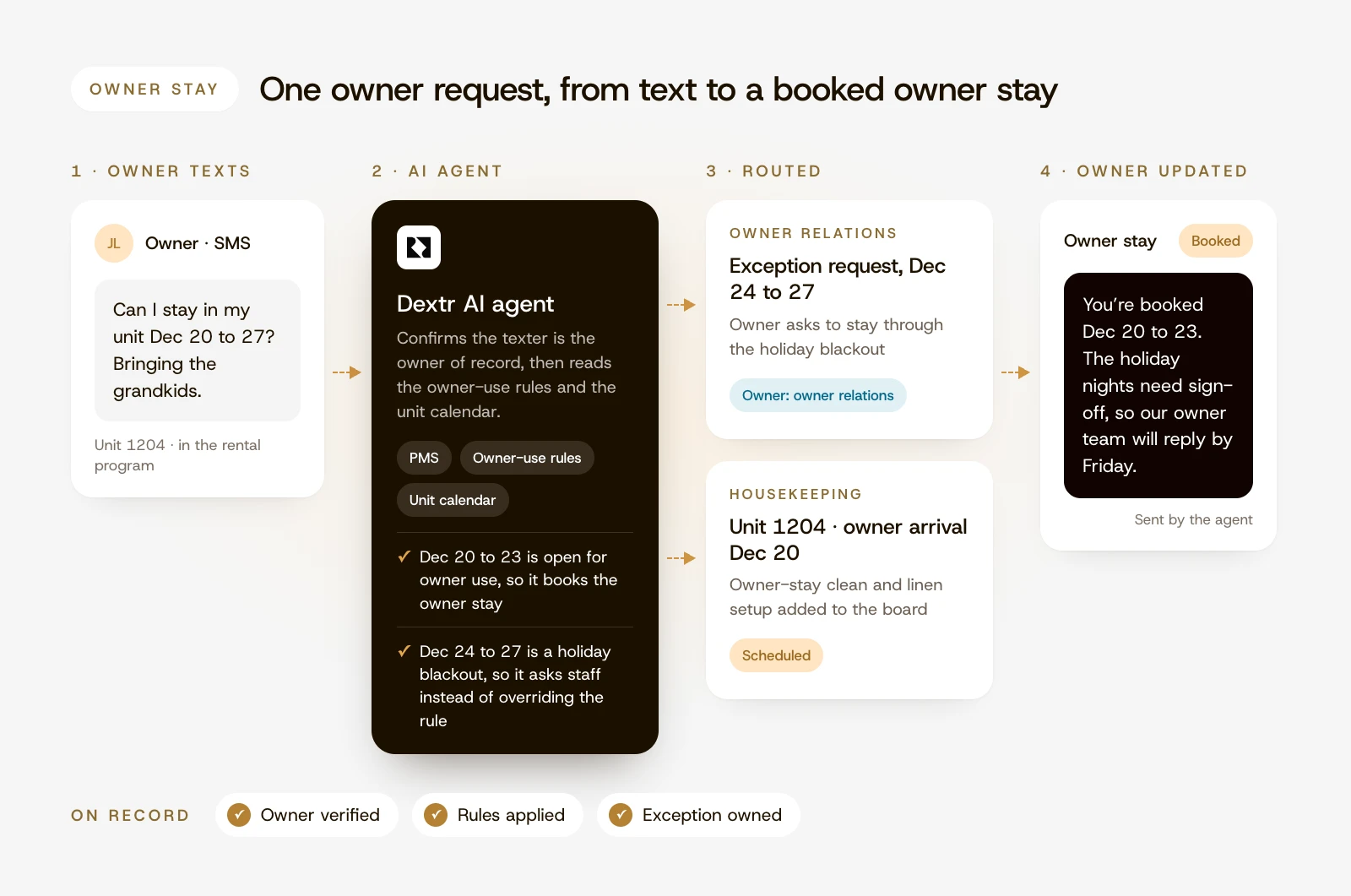
Owner: “Can I stay in my unit December 20 to 27?”
Verify the owner, check owner-use rules and the unit calendar, book the owner stay
Exceptions to owner-use rules
Owner: “Why was my unit empty last week?”
Share the nights, rates and policy the owner is allowed to see
Disputes and statement adjustments
Guest or owner: “The AC in 1204 is broken.”
Open a work order; ask the owner to approve if the cost passes their limit
Vendor choice and large repairs
Prospective buyer: “What will a unit earn if I join the program?”
Say that a rental program exists and hand off to the licensed sales or rental team
Everything about income, occupancy and returns
The first decision an AI agent makes is who it is talking to. PMSs already treat owner reservations as their own reservation type, so the agent should do the same: match owners to a verified phone number or email on file and, for anything financial, run a second check. A caller who says “I own 1204” should not hear a statement until that is confirmed.
8 Jobs an AI Agent Can Take On in a Condo Hotel
Three of these jobs, guest bookings, check-in and winning back past guests, work much as they do with AI in any hotel. The other five exist or change because owners and residents share the building.
1. Answer and Book Guest Calls and Messages Around the Clock
A lean condo hotel may have few people on duty overnight, and calls that reach voicemail can turn into bookings on an OTA, or with a competitor. An AI agent connected to the PMS can answer every call and message, check live availability by unit type, quote the total price including resort fees and taxes, book direct and take the deposit. Our comparison of AI voice agents for hotels shows which ones book and take payment on the call.
Direct bookings matter to two parties here, not one. OTA commissions commonly run 15% to 30% or more, and where commissions come off the nightly rate before the 50/50 split, as credit card and travel agent fees do at Big Sky Resort, an OTA commission reduces both the owner’s and the operator’s share. A booking moved to the property’s own phone line or website is worth more to both. One condo-hotel operator, Brittain Resorts, warns that “many condo hotels fall into the trap of heavy OTA dependence” (Brittain Resorts). Check how your own agreement treats commissions before you quote this to owners.
2. Run Check-In and Door Codes When No One Is at the Desk
Late arrivals are the hardest moment in a lean building, and guests are ready for self-service: in a 2025 Mews survey, 70% of American travelers said they were likely to check themselves into a hotel. Pre-arrival check-in on the guest’s phone, with ID and card authorization, followed by a door code that works only for that unit and only during the stay, lets guests arrive at any hour. Codes should go out only after the unit is inspected, and should change when a guest moves units or extends.
Condo buildings add a second layer: the building entrance, garage and amenity doors that owners and residents also use. Guest credentials should open what a guest needs and nothing more, expire with the stay, and never be issued for units in owner use. When a code fails, the AI agent can verify the guest, check the lock and resend it, and call the on-call manager if the lock itself has failed. Dextr AI’s guide to automating a hotel walks through that late-arrival test step by step.
3. Handle Owner Stays Inside the Rules
Owner stays are where a condo hotel most often frustrates its owners: a request sits in an inbox, the dates turn out to be blacked out, and housekeeping hears about the arrival on the day. An AI agent can take the request by text, email or phone, confirm the owner, read the owner-use rules and the unit calendar, book the nights the agreement allows as an owner reservation and pass any exception to the person who decides. If the owner is sending friends or family, the agent records who is staying at the time of the reservation, as programs such as Big Sky Resort’s require.
The agent should never override a blackout or move a guest out of a unit to make room for its owner. It books what the rules allow, explains what they do not, and gives the exception to owner relations with the request attached. The owner gets an answer in minutes instead of days, and housekeeping gets the owner-arrival clean on the board.
4. Answer Owner Questions With the Data They Are Allowed to See
Owners ask the same questions every month: how many nights did my unit rent, at what rate, why was it empty last week, when is my payout, what is this charge? Answering them by hand means pulling reports and reconciling settlements for each unit. An AI agent can answer from the PMS and owner-statement data a verified owner is entitled to see, explain the policy behind a number, and send anything disputed to the accounting or owner-relations team.
Two limits apply. The agent should not discuss another owner’s unit, and it should never forecast what a unit will earn, how full it will be or what it will save in tax. Those questions go to a person, for the legal reasons below.
5. Keep Room Assignment Fair
Fair distribution is the promise that holds a rental program together. Lodgical Solution, a PMS with a module built for condo hotels, puts it plainly: “The goal of a condo-hotel is to balance payout across all owners.” PMSs do this in different ways. Resort Data Processing’s pooled owner accounting averages pooled revenue per rental night by room type and keeps owner stays out of the pool (RDP). Maestro offers rental pool controls and equalization of rental revenues (Maestro). OPERA Cloud tracks rotation points and can require a reason whenever staff pick a room that is not next in the rotation sequence (Oracle).
That rule breaks easily when people, or an AI, assign units by hand. The safe pattern is for the AI agent to book by unit type and let the PMS assign the unit, the same way a website booking would. Exceptions, such as a guest who asks for the unit they had last year or an accessibility need, should go through the PMS’s override with a reason. Owners who doubt the rotation will ask for that record, and an operator that can show it rarely has the argument twice.
6. Route Housekeeping and Maintenance Across Owned Units
Every unit has an owner, so maintenance has an extra step. An AI agent can turn a guest report into a work order with the unit, time and urgency attached, then, if the estimated cost passes the owner’s approval limit, send the owner the request and record the answer. Urgent safety repairs follow the agreement’s emergency terms rather than waiting for a reply.
Downtime also affects fairness. OPERA Cloud adjusts rotation points for rooms that are out of order or out of service, so each work order should record whether the owner, the guest or the property caused the downtime, because that decides who is billed and how the rotation counts it. Housekeeping needs the same awareness: units in owner use or outside the program should not appear on the guest cleaning board, owner arrivals need their own preparation, and owner-occupied units should be left out of guest messages, upsells and digital keys.
7. Keep Guests and Residents on Good Terms
Condo hotels often share hallways, pools and parking with owners in residence. Guests who do not know the building rules, such as quiet hours, pool times, parking spaces and which elevator to use, are an easy source of friction with residents. An AI agent can send the building rules before arrival, answer questions about them at any hour, and pass noise or security reports to the on-call person immediately.
8. Bring Past Guests Back Direct
A guest who booked through an OTA once can book direct the next time. Segmenting past guests and sending approved campaigns for the dates the building needs to fill helps both owners and the operator. Keep guest marketing separate from anything aimed at prospective buyers, and keep a named person’s approval on every campaign: in a condo hotel, that approval is a compliance control as well as a brand one.
Rules an AI Agent Must Respect in a Condo Hotel
This section summarizes public rules and guidance; it is not legal advice. Have counsel review your agent’s scripts and rules.
No income, occupancy or tax-benefit claims. In its 1973 guidance, the SEC said condo units offered with a rental arrangement will be deemed securities if they are sold through “advertising, sales literature, promotional schemes or oral representations which emphasize the economic benefits to the purchaser” from the promoter’s management, and also where there is a rental pool or the buyer must make the unit available for rental (SEC Release 33-5347). In the 2002 Intrawest no-action letter, the developer committed that sales materials and representatives would not discuss economic or tax benefits and that “Projections of future rental income or expected occupancy rates will not be provided” (SEC). An AI agent that speaks to buyers or owners is making oral representations, so it should state facts, never forecasts, and never imply the rental program is required.
The rental management agreement. Owner-use limits, blackout dates, rotation, approval limits and statement access come from the agreement. Turn each clause into a rule the agent follows, and keep the exceptions with people.
Licensing. Short-term rental of condo units usually needs a lodging license. In Florida, a vacation rental includes any unit in a condominium that is also a transient public lodging establishment (Florida Statutes 509.242), and the state licenses it accordingly.
Taxes in the quoted price. Lodging taxes change, and the agent must quote the current total. Hawaii’s transient accommodations tax rose to 11% on January 1, 2026 (Hawaii Tribune-Herald).
Local short-term rental rules. Zoning can end short stays in condo buildings. Maui County’s Bill 9, signed in December 2025, phases out about 7,000 short-term rentals in apartment-zoned districts by January 1, 2029 in West Maui and January 1, 2031 elsewhere; hotel-zoned condo hotels are outside it (Hawaiʻi Public Radio; Maui Now). In June 2026 the council approved new hotel zoning districts, a path for about 4,500 of those units to keep short stays if their buildings are rezoned (Maui Now). On Oʻahu, a 2022 ordinance set a 90-day minimum stay in most neighborhoods outside resort zones (Civil Beat), though a federal court has barred the city from enforcing it against 30-to-89-day rentals that were operating legally before it took effect (Honolulu Star-Advertiser). Build these limits into the booking rules, so the agent cannot sell a stay the zoning does not allow.
Owner and guest privacy. Owner statements are financial records, and guest details are personal data. Verify identity before sharing either, and limit what the agent can see to what its job needs.
AI disclosure. Some states set rules here. Utah requires a business to disclose generative AI when a consumer clearly asks, and protects businesses that disclose it at the start of and throughout each interaction (Davis Polk). Have the agent say it is an AI at the start of each call or chat, and offer a route to a person.
The Systems Condo Hotels Run, and Why Integration Decides Everything
Condo hotels need a PMS that does what a hotel PMS does and also handles owners: owner accounting, revenue splits, owner statements and payouts, owner reservations, and rotation or rental pools.
System
Owner features its vendor documents
Resort Data Processing (RDP)
Pooled owner accounting and condominium owner accounting modules
Maestro
Rental pool controls, revenue equalization and an online owner booking and statement portal
OPERA Cloud
Room rotation points, with owner, out-of-order and out-of-service adjustments
Infor HMS
Owner room rotation point totals by period (Infor)
Lodgical Solution
Rotation, an owner portal for owner-stay bookings, owner payments and fees
Streamline
Monthly owner statements with payouts by ACH (Streamline)
An AI agent is only as useful as its access to that system. If it cannot read the unit calendar, it cannot book an owner stay. If it cannot write reservations, staff rekey every booking it takes. If it assigns units outside the PMS, it breaks the rotation. Before you choose a vendor, ask whether it reads and writes to your PMS today, and follow the steps in Dextr AI’s guide to connecting AI to your PMS.
A 30-Day Rollout Plan
Week 1: write the rulebook.
Turn the rental management agreement into rules: owner-use limits and blackouts, approval limits, what owners may see, who handles exceptions at each hour. Write down what the agent must never say, starting with income and occupancy forecasts, and have counsel review it. Build a verified owner directory with phone numbers and emails.
Week 2: connect and test.
Connect the PMS, the lock platform and the payment gateway. Test guest bookings by unit type, owner stays inside and outside the rules, a buyer asking about returns, a failed door code and a repair over an owner’s limit. Confirm that the PMS, not the agent, assigns units.
Week 3: guests first.
Put the agent live on after-hours guest calls and messages. Run owner requests in shadow mode, with staff approving each answer before it goes out.
Week 4: owners next.
Switch on owner requests, tell owners how to reach the agent and what it can do, and review the first month’s numbers with the board or owner committee.
What to Measure
Metric
Why the operator cares
Why owners care
Direct-booking share
Lower commissions, guest data
Higher payouts where commissions come off the top
After-hours calls answered and booked
Recovered revenue
More nights for their unit
Owner request response time
Fewer escalations, owners who stay in the program
An answer in minutes, not days
Rotation overrides, with reasons
Proof the rotation is followed
Fair treatment
Lockout and access calls per 100 arrivals
Overnight workload
Security of their unit
Work orders closed inside approved limits
Maintenance control
No surprise charges
Where Dextr AI Fits
Dextr AI is an AI workforce platform for hospitality. Its AI agents answer calls and messages, book stays and take deposits, run check-in, housekeeping and maintenance, and market to past guests, inside the PMS a property already uses. For a condo hotel, that maps to both customers:
Guests: Daisy, the AI voice agent, answers every call 24/7 and books stays into the PMS. Alfred, the AI guest concierge, runs contactless check-in and sends door codes through RemoteLock.
Owners: whether the agents take any owner requests, such as owner-stay bookings, is decided with each building during setup, and decisions stay with your team.
Operations: Manny, the AI operations agent, builds the housekeeping board and assigns work orders. Cosmo drafts direct-marketing campaigns that wait for a named person’s approval before they are sent.
Control: managers use DOSS to change rules and escalations in plain English, such as “send any owner statement dispute to owner relations within an hour.”
Dextr AI has more than 60 live integrations, including Resort Data Processing, Maestro, SMS Host, Infor HMS, Streamline, Escapia, TravelNet Solutions (Track), BrightSide and CiiRUS, plus OPERA Cloud, Stayntouch, Mews, Cloudbeds, Hostaway and Guesty. A forward-deployed engineer sets up each property’s rules. Dextr AI’s standard go-live is seven days per property, from kickoff, which covers connecting the PMS, locks and payments; the 30-day plan above leaves extra time for counsel to review the rulebook and for owner requests to run in shadow mode. Teams running several buildings can see them in one place, as described on the property management and short-term rentals pages.
The Bottom Line
A condo hotel runs on two kinds of trust: guests trust it to work like a hotel, and owners trust it to treat their unit fairly. AI agents help with both when they know who they are talking to, follow the rental management agreement, let the PMS assign units, never talk about expected income and hand exceptions to people. Start with after-hours guest calls and owner-stay requests, then add owner questions and maintenance approvals once the rules hold.
Frequently Asked Questions
What is a condo hotel?
A condo hotel, or condotel, is a building that is legally a condominium but operates as a hotel. Units are individually owned, and owners who join the rental program have their unit rented to guests. Room revenue is shared between the owner and the operator, often around 50/50, though splits range from about 40/60 to 60/40 and some costs come off the top first.
How can AI help a condo hotel?
AI agents can answer and book guest calls and messages 24/7, run check-in and door codes, route housekeeping and maintenance, take owner-stay requests and answer owner questions from the data owners may see, all inside the rental program’s rules.
Can an AI agent answer questions from unit owners?
Yes, once the owner is verified. It can explain nights rented, rates and charges from the owner’s own statement data and book owner stays the rules allow. Disputes, exceptions and anything about future income should go to a person.
Will an AI agent keep the rental rotation fair?
It should not assign units itself. The safe setup is for the agent to book by unit type and let the PMS assign the unit under the program’s rotation or pooling rules, with any override recorded with a reason.
Is a condo hotel rental program a security?
It can be. The SEC said in 1973 that condo units offered with an emphasis on rental income, with a rental pool, or with a required rental arrangement can be securities. That is why sales materials, staff and AI agents should never discuss expected income, occupancy or tax benefits. Ask counsel about your program.
Do owners lose rental income when they use their unit?
In programs where each unit earns its own revenue, nights an owner uses are nights the unit is not rented. In pooled programs, owners share pooled rental revenue by formula, and owner stays are kept out of the pool. The rental management agreement says which applies.
Which PMS do condo hotels use?
Condo hotels need owner accounting, owner statements, owner reservations and rotation or pooling as well as hotel features. Resort Data Processing, Maestro, OPERA Cloud, Infor HMS, Lodgical Solution and Streamline all document owner features of this kind, and vacation rental systems such as Escapia and Track offer owner portals. Dextr AI integrates with most of them.
What’s the difference between a hotel and a condo hotel?
A hotel has one owner and fixed inventory. A condo hotel has many unit owners, inventory that changes as owners use their units or leave the program, revenue split with each owner, rotation rules for assigning units, and repairs that may need an owner’s approval.
Growth and search specialist with hands-on experience in the AI sector. Covers AI agents, voice AI and automation, and how businesses evaluate and adopt them.
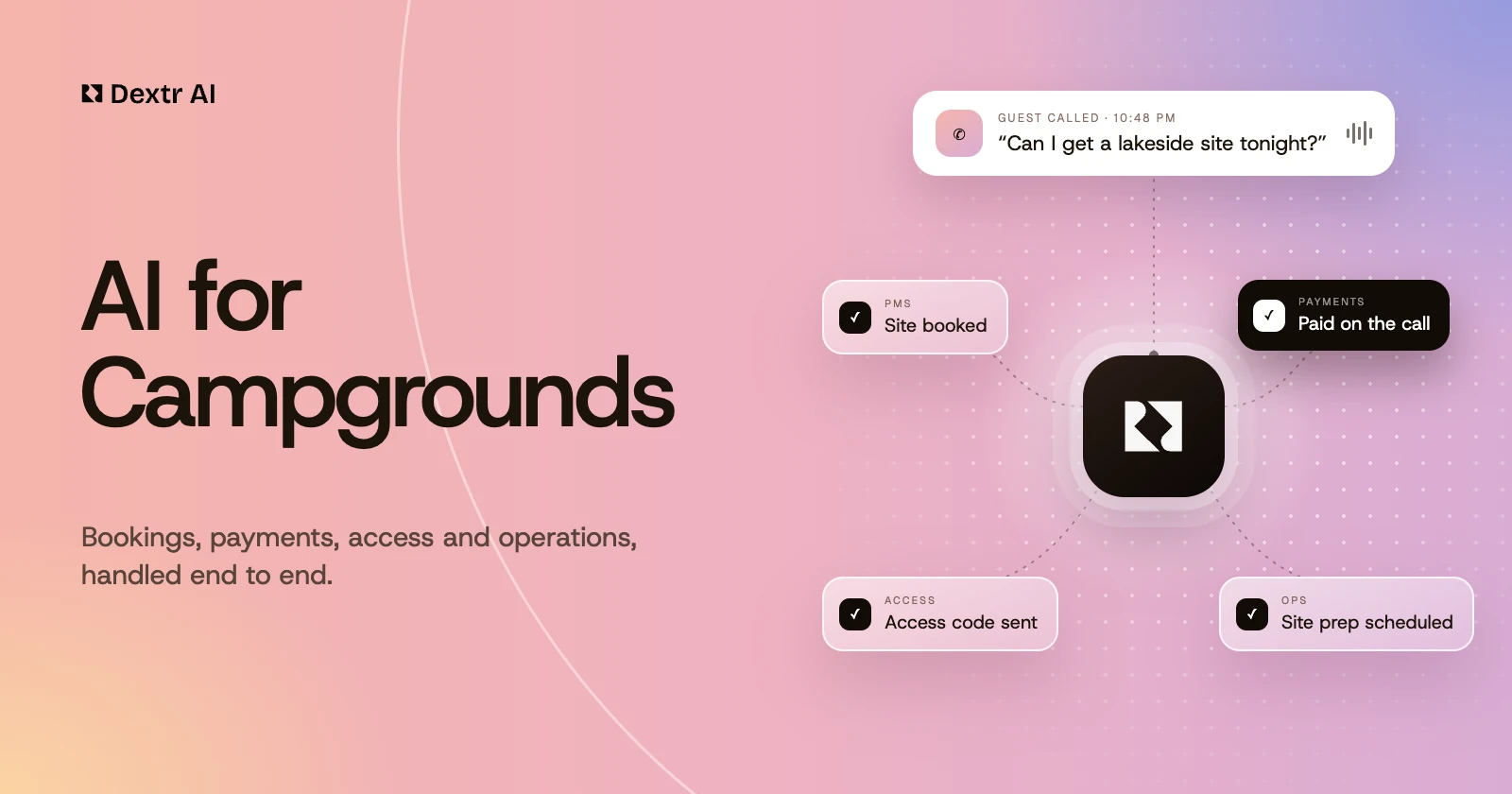
Campers call and text at all hours, and most campgrounds run on a lean front desk. How AI agents can book sites, take payment, send access codes, route site prep and keep guests informed when the weather turns.
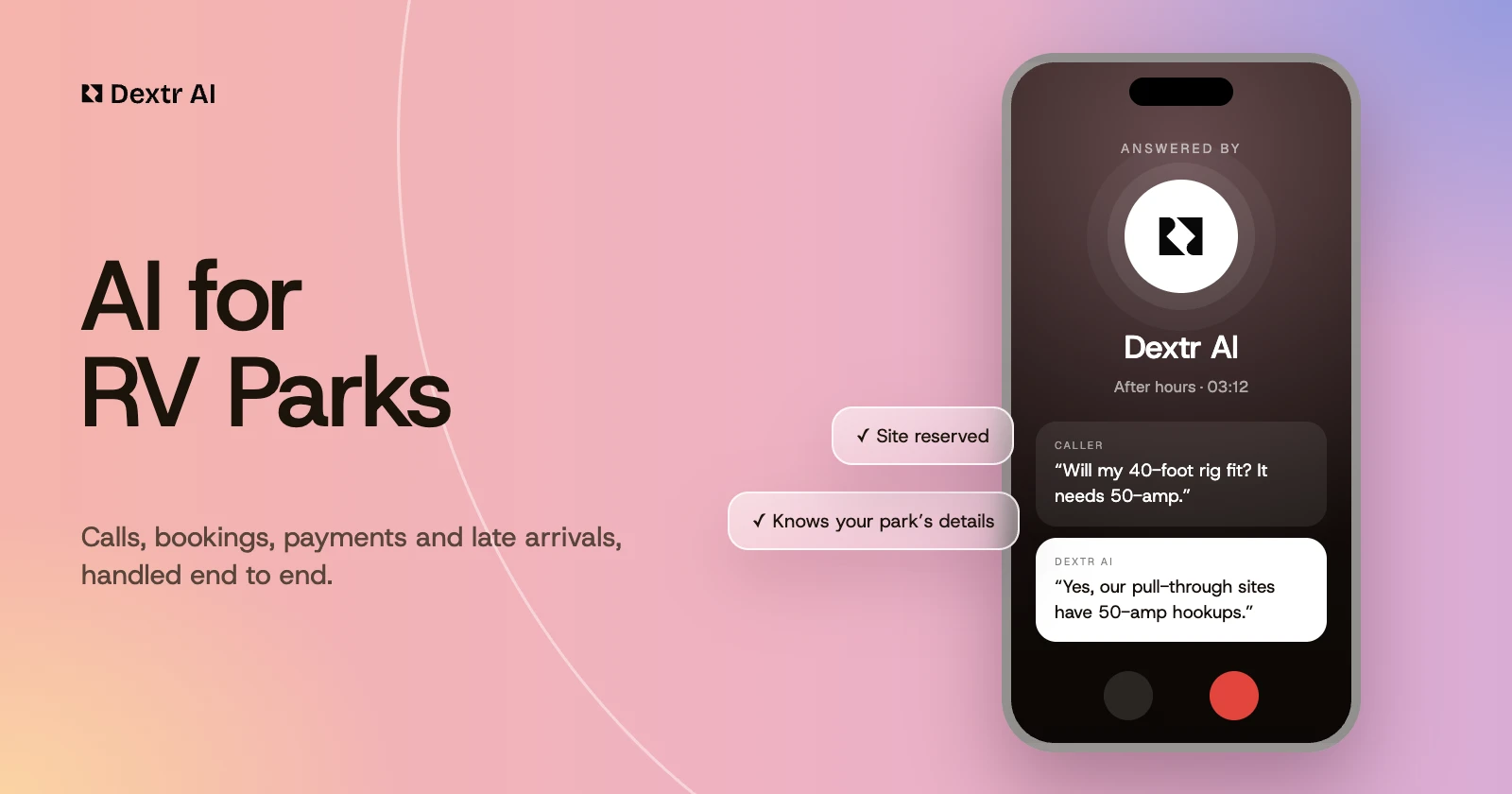
RV parks get questions hotels never do: rig length, amperage, pull-throughs, monthly rates. How AI agents can answer them, book and take payment on the call, and leave the exceptions to your team.
Beyond the headlines about queues and dynamic pricing: how AI agents can sell tickets, handle season passes and group bookings, and answer guests at any hour, and what staff should keep.
Deepak Sharma · Read article
Ready to grow your business?
×
The demo scheduler is provided by HubSpot and uses functional cookies. Allow functional cookies to book a time here, open the scheduler on HubSpot's site, or use the Inquiry tab.