We use cookies to run this site. With your consent, we also use them for our demo scheduler, analytics and marketing, including identifying the companies and people who visit us. Change your choice anytime under "Cookie Preferences".Privacy Policy
🚀 Dextr AI raised $6.7M to bring an AI workforce to hospitality. Learn more 🚀 Dextr AI raised $6.7M to bring an AI workforce to hospitality. Learn more
GuideTheme Park OperatorsWater ParksFamily Entertainment Centers
AI in Theme Parks: Where It Helps and Where It Doesn’t
Most writing about AI in theme parks is about queues, ride sensors and dynamic pricing at the biggest resorts. This guide covers the part every park can use now: AI agents that sell tickets, handle season passes and groups, and answer guests at any hour, and what your team should keep.
AI for theme parks means using artificial intelligence to run a park and serve its guests: forecasting crowds, predicting ride maintenance, setting prices and, most practically for the majority of parks, answering and acting on guest calls and messages. AI agents can sell tickets and season passes, book groups and birthday parties, take payment, answer questions about hours, height rules and weather, and route problems to the right team, by phone, text, WhatsApp, email and web chat, 24 hours a day.
The big resorts get the headlines. But a regional park, water park or family entertainment center (FEC) faces the same problem every weekend: the phone rings most when staff are busiest, and families who cannot get an answer plan a different day out. This guide explains where AI helps a park of any size, which jobs to hand to AI agents first, and which decisions should always stay with people.
Key takeaways
AI in theme parks covers two different things: park-wide systems such as crowd forecasting, predictive maintenance and dynamic pricing, and AI agents that handle guest conversations. The second is the one most parks can put to work in weeks.
Guest questions repeat: hours, tickets, season-pass benefits, height requirements, weather, parking, accessibility, lost items. Answering them from the park’s own information is the first job to automate.
The money is in finishing the job, not just answering: quoting tickets, taking payment, booking group and birthday packages, renewing passes and offering add-ons such as parking or dining in the same conversation.
Safety stays human. An AI agent can tell a guest a ride’s posted height requirement or that it is closed for weather; it should never decide whether a ride is safe to run or make exceptions to a safety rule.
Start with after-hours calls and messages and the top 20 guest questions, then add payments, season passes and groups, and measure answer rate, tickets sold by the AI and handoffs to staff.
How Theme Parks Use AI Today
Industry writing on AI in attractions keeps coming back to the same few areas. IAAPA’s Funworld magazine lists chatbots and virtual assistants for “real-time customer service,” crowd tools that “optimize crowd flow, directing visitors to less crowded areas of the park,” “predictive maintenance of rides and infrastructure” and “real-time, dynamic pricing for tickets, food, and merchandise” (IAAPA Funworld, 2024). A 2026 Blooloop analysis describes the same pattern: learning algorithms that “sort through years of operational and repair records” to flag mechanical problems early, and crowd forecasts that let operators “adjust staffing levels, entertainment schedules, or food and beverage operations” before congestion builds (Blooloop, 2026).
Area
What AI does
Who it suits
Guest conversations
Answers calls and messages, sells tickets and passes, books groups, takes payment, routes issues
Any park, water park or FEC, from week one
Crowds and queues
Forecasts attendance, adjusts virtual-queue times, points guests to shorter waits
Parks with ticketing, app or queue data to learn from
Ride maintenance
Spots warning signs in maintenance records and sensor data so repairs can be planned
Parks with years of digital maintenance records; always under engineers
Pricing
Moves ticket, food or merchandise prices with demand
Parks with enough demand data and a clear fairness policy
Marketing
Drafts campaigns, segments pass holders, follows up group leads
Any park with a guest list
Pricing is where the largest operators are moving. Disney’s chief financial officer, Hugh Johnston, said in November 2025 that the company has been running dynamic pricing at Disneyland Paris for about a year, that “it’s off to a very good start,” and that Disney will “make sure we optimize it before we bring it into the domestic parks” (TheWrap). Blooloop’s analysis adds a caution from other industries: pricing algorithms have raised fairness concerns when different customers pay different prices for the same thing.
Both sources agree on one more point. Funworld quotes the view that AI is “a sidekick, not a solution,” and Blooloop warns that “the quality of an AI system is only as good as the data it is trained on” and that operators need “clear policies governing data privacy, algorithmic decision-making and responsible AI deployment.” For a regional park, that points to a sensible order: start where the data is simple and the risk is low, which is guest conversations, and build toward the rest.
What Guests Ask, and What an AI Agent Can Do About It
Guest services teams know the pattern. The same questions arrive by phone, text, social media and email, and they peak on the days the team is busiest at the gate.
Guest asks
What an AI agent can do
What staff keep
“Can I get 4 tickets for Saturday?”
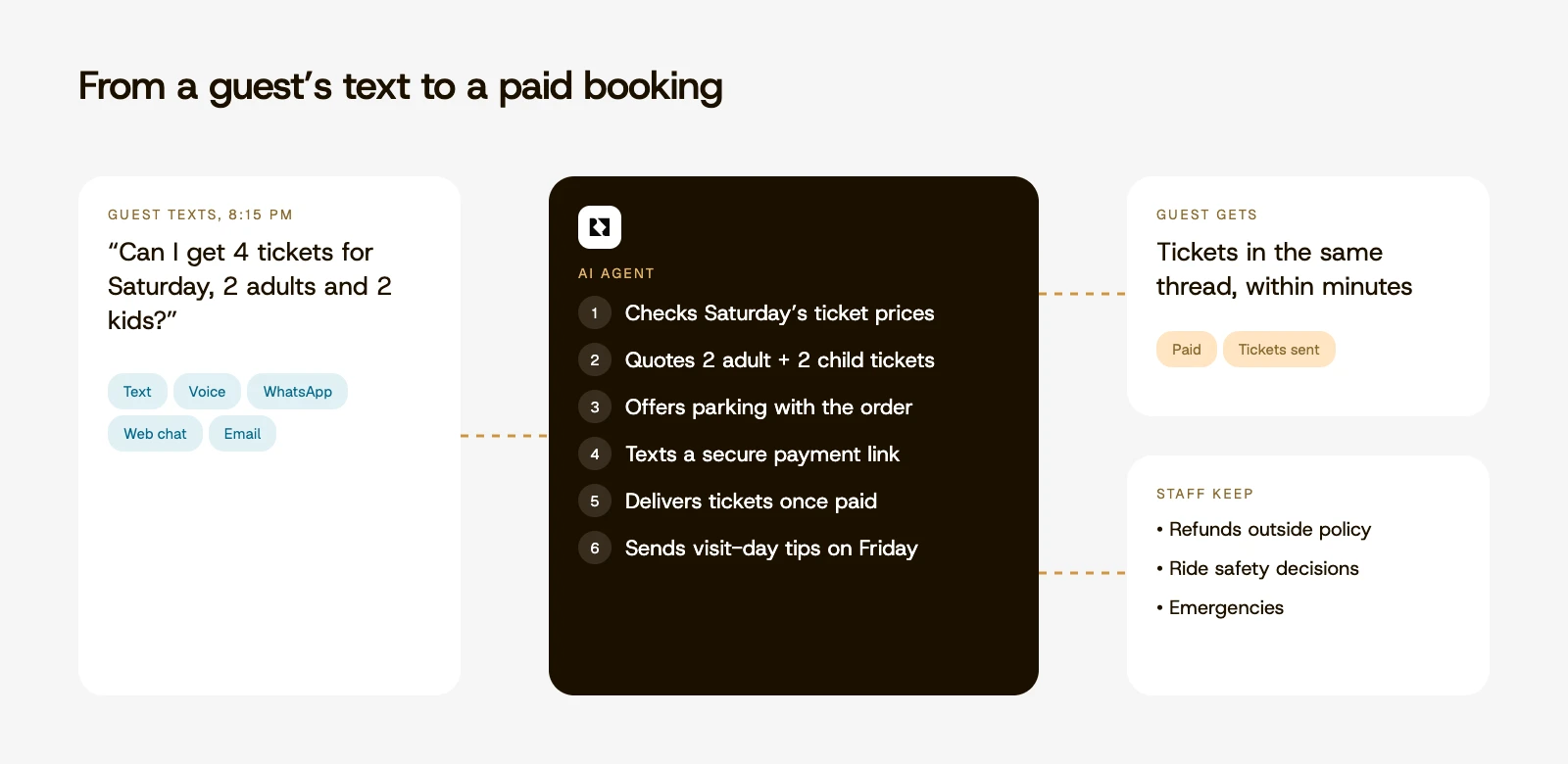
Quote the date’s price, send a payment link and deliver the tickets
Price exceptions and refunds outside policy
“Does my season pass include the water park?”
Look up the pass, explain benefits and blackout dates, offer a renewal or upgrade
Pass disputes and goodwill extensions
“How tall do you have to be for the big coaster?”
Give the posted height requirement and similar rides for smaller guests
Any exception to a ride rule (there are none to give)
“Is the park open? It’s raining.”
Share the current status your team has published and what closes in lightning
Deciding to close rides or the park
“We want a birthday party for 15 kids.”
Quote packages, check dates, take the deposit and confirm the details
Custom packages and large corporate events
“My son left his phone on the log flume.”
Log the item and contact details and pass them to lost and found
Matching and returning the item
“What accessibility services do you offer?”
Explain the park’s published accessibility program and how to register
Individual accommodations and judgment calls
Most of these are lookups against information the park already has: ticket prices by date, pass benefits, ride requirements, published policies. The rest are transactions the park already sells. That is why guest conversations are the fastest place to start.
8 Jobs an AI Agent Can Take On at a Theme Park
Some of these jobs work much as they do in hotels, such as answering calls and taking payment. Others, such as season passes, ride questions and weather updates, are specific to parks.
1. Sell Tickets on Every Channel, at Any Hour
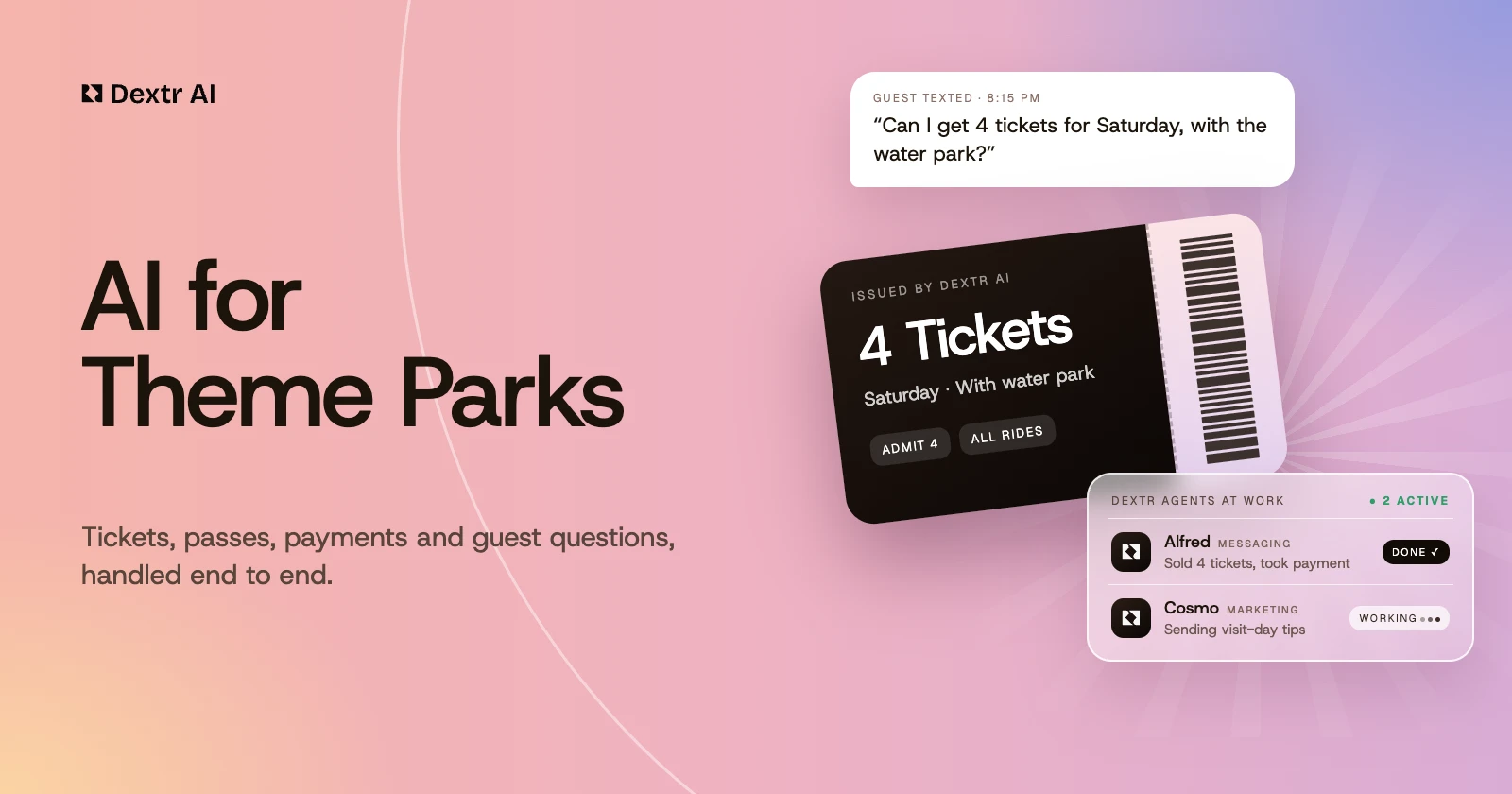
Families plan trips in the evening, after work and after the kids are asleep, which is exactly when the ticket office is closed. An AI agent connected to the ticketing system can answer the call or message, check the date, quote adult and child tickets, send a secure payment link and deliver the tickets the moment the guest pays. The same agent works across voice, text, WhatsApp, email, social media and web chat, so a guest gets the same answer wherever they ask.
The difference from a simple chatbot is that the conversation ends with a sale, not with “please visit our website.” A guest who asked a question and was handed a link may never come back; a guest who gets tickets in the same thread is already planning the day.
2. Handle Season-Pass Questions, Renewals and Upgrades
Season-pass holders are a park’s most loyal guests, and they generate a steady stream of questions: what does my pass include, which dates are blocked out, can I add parking, how do I change the name on a pass, when does it expire? Each one is a lookup, and many end in a sale. An AI agent can look up the pass, explain its benefits and blackout dates, remind holders before it expires and handle the renewal or upgrade in the same conversation, so the questions stop queuing up at the guest services window.
3. Book Groups, Birthday Parties and School Trips
Group and party inquiries are valuable and slow: a parent planning a birthday, a teacher planning a school trip, an HR team planning a company day. They often arrive by email or web form and wait for a sales call. An AI agent can quote the published packages, check availability for the date, collect headcounts and dietary needs, take the deposit and send the confirmation. It can follow up a quote that went quiet, which is where many group leads are lost. Custom packages and large corporate events go to the sales team with every detail already collected.
4. Answer the Questions Guests Ask a Thousand Times a Day
Opening hours, parking, bag policy, outside food, height requirements, show times, directions, restroom and first-aid locations, accessibility services. An AI agent can answer all of them instantly, from the park’s own information, in the language the guest writes or speaks in. The rule is simple: the agent answers from what the park has published, and if the answer is not there, it says so and hands off rather than guessing.
Height requirements are a good example. The agent should give each ride’s posted requirement exactly as the park lists it, suggest rides that suit smaller guests and never imply that an exception might be made at the ride entrance.
5. Push Weather Holds, Closures and Schedule Changes
When a storm rolls in, guest services is flooded with the same question: is the park open, which rides are running, will I get a rain check? Updating the phone message, website, social accounts and every guest one by one takes hours. An AI agent can send one broadcast to guests who opted in, answer follow-up questions from the status your team has published and explain the park’s weather policy. The decision to close a ride or the park stays with operations; the agent only communicates it.
6. Take Payments and Offer Add-Ons at the Right Moment
Many guest conversations are one step from extra revenue: parking with tickets, a meal deal with a birthday package, a cabana on a hot weekend, a pass upgrade for a family that visits often. An AI agent can offer the add-on that fits the conversation and take payment by secure link in the same thread. The test is relevance: one useful offer at the right moment, not a list of everything the park sells.
7. Market to Pass Holders and Past Guests
A park’s guest list is its cheapest source of repeat visits. AI can draft campaigns for pass renewals, off-peak days, new rides and seasonal events, segment guests by what they bought, and follow up interest from the conversations the agents already had. Keep a person in the approval loop for anything that goes out to the whole list, and follow the consent rules for texts and emails in your market.
8. Route Lost Items, Maintenance and Feedback to the Right Team
Not every message is a sale. A guest reports a lost phone, a broken hand dryer, a long wait at a food stand or a bad experience on a ride. An AI agent can log each one with the details staff need, send it to the right team, such as lost and found, maintenance or guest relations, and follow up with the guest. Checking in during a visit can catch a bad experience while the guest is still in the park, before it becomes a review.
What Staff Should Always Keep
The line between what AI does and what people decide is clearer in a theme park than almost anywhere else, because some decisions involve guest safety.
Ride safety. Whether a ride runs, closes or reopens, and every rider eligibility decision at the ride, belongs to trained operators and maintenance teams. An AI agent communicates these decisions; it never makes them.
Emergencies. A medical problem, a missing child or a security concern must go straight to people, with the agent giving the guest the right number or location and alerting staff.
Exceptions. Refunds outside policy, goodwill gestures and individual accessibility accommodations need human judgment.
Predictive maintenance. Where a park uses AI to flag possible ride faults, the output is advice for engineers, who decide what to inspect and when.
Write these rules down before go-live, test them with real scenarios, and make sure every handoff reaches a named team at every hour the park is open.
A 30-Day Rollout Plan
Week 1: collect the answers.
Gather what the agent will answer from: ticket prices and rules by date, season-pass benefits and blackout dates, group and party packages, ride height requirements, park hours, weather and refund policies, accessibility information. Pull the top 20 questions from call logs, messages and staff. List what the agent must hand off, starting with safety and emergencies.
Week 2: connect and test.
Connect the ticketing and point-of-sale system, the payment gateway and the guest list. Test a ticket sale, a pass renewal, a birthday booking, a height question, a weather closure, a lost item and an emergency handoff.
Week 3: go live after hours.
Put the agent on calls and messages outside office hours first, with staff reviewing conversations each morning.
Week 4: extend.
Add daytime overflow, season-pass renewals, group follow-up and weather broadcasts, and review the first month’s numbers with the guest services and sales teams.
What to Measure
Metric
Why it matters
Calls and messages answered
Shows how many guests now get an answer, especially after hours and on peak days
Tickets and passes sold by the agent
Revenue that would otherwise have waited or been lost
Group and party leads converted
High-value bookings that often stall without follow-up
Season-pass renewal rate
Your most loyal guests, and recurring revenue
Add-on revenue per conversation
Whether offers are relevant enough to be accepted
Handoffs to staff, with reasons
Where the agent needs better information, and where people are essential
Guest satisfaction and review scores
Whether faster answers show up in how guests rate the visit
Where Dextr AI Fits
Dextr AI is an AI workforce platform for hospitality and attractions. For theme parks, its AI agents handle ticket sales, guest questions and park operations across voice, text, WhatsApp, email, social and web chat:
Tickets and bookings: Daisy, the AI voice agent, answers calls 24/7, sells tickets and season passes, checks hours and availability, handles changes and takes payment.
Guest messaging: Alfred, the AI guest concierge, answers guests by text and chat on rides, shows and accessibility, offers add-ons and catches problems early.
Operations: Manny, the AI operations agent, routes maintenance, cleaning, ride downtime and staff follow-ups.
Marketing: Cosmo supports direct marketing, from season-pass renewals to guest re-engagement and group follow-up.
Control: managers set rules and escalations in plain English with DOSS, and edge cases go to your team.
Dextr AI’s agents already run guest conversations at outdoor hospitality businesses, including a riverfront campground that used them to handle more than 5,000 guest conversations; our guides to AI for campgrounds and AI for RV parks cover those properties. For how the voice side works, see our guide to AI voice agents.
The Bottom Line
AI in theme parks is not only for resorts with data science teams. Every park, water park and FEC has guests asking the same questions and trying to buy tickets when no one is free to answer. AI agents that answer from the park’s own information, finish the sale, hand safety and exceptions to people and follow up afterward are the practical place to start. Crowd forecasting, predictive maintenance and pricing can follow as your data grows.
Frequently Asked Questions
How is AI used in theme parks?
Theme parks use AI for guest service (chatbots and voice agents that answer questions and sell tickets), crowd and queue management, predictive maintenance of rides, dynamic pricing and marketing. For most regional parks, water parks and family entertainment centers, AI agents that handle guest calls and messages are the quickest place to start.
Can an AI agent sell theme park tickets?
Yes. Connected to the park’s ticketing system, an AI agent can quote tickets for a date, send a secure payment link and deliver the tickets after payment, by phone, text, chat or email, at any hour.
Can AI handle season-pass renewals?
Yes. An AI agent can look up a pass, explain its benefits and blackout dates, remind holders before it expires and complete the renewal or upgrade in the same conversation. Disputes and goodwill extensions should go to staff.
Should AI make ride safety decisions?
No. An AI agent can share a ride’s posted height requirement or tell guests a ride is closed for weather, but decisions about whether a ride runs and who may ride belong to trained operators and maintenance teams.
Does dynamic pricing use AI?
It can. Dynamic pricing moves prices with demand, and AI models can forecast that demand. Disney has said it has run dynamic pricing at Disneyland Paris for about a year and plans to optimize it before bringing it to its U.S. parks. Parks considering it should set a clear fairness policy first.
Is AI only for large theme parks?
No. Crowd forecasting and predictive maintenance need years of data, but AI agents for tickets, passes, groups and guest questions work for parks of any size, because they run on information the park already has.
How long does it take to set up AI agents at a park?
A focused rollout takes about a month: a week to gather prices, policies and the top guest questions, a week to connect and test the ticketing and payment systems, then after-hours go-live and extension to daytime overflow, passes and groups.
Growth and search specialist with hands-on experience in the AI sector. Covers AI agents, voice AI and automation, and how businesses evaluate and adopt them.
Campers call and text at all hours, and most campgrounds run on a lean front desk. How AI agents can book sites, take payment, send access codes, route site prep and keep guests informed when the weather turns.
RV parks get questions hotels never do: rig length, amperage, pull-throughs, monthly rates. How AI agents can answer them, book and take payment on the call, and leave the exceptions to your team.
A condo hotel answers to guests and to the owners of every unit. How AI agents can book guests, answer owners, follow rental-program rules and keep a lean team in control.
Deepak Sharma · Read article
Ready to grow your business?
×
The demo scheduler is provided by HubSpot and uses functional cookies. Allow functional cookies to book a time here, open the scheduler on HubSpot's site, or use the Inquiry tab.